

Before the start of the current school year, a meeting was held that ultimately decided on merging Future Business Leaders of America (FBLA) with Distributive Education Clubs of America (DECA) starting next year.
The meeting included Career and Technical Education (CTE) coordinator Tiauna Young and Principal Chip Greenwell along with students involved in FBLA. FBLA has been a well involved club at Heritage since its beginning with around 88 members and 42 competitors this year. DECA on the other hand has around 55 members and 15 competitors this year. Despite this, there are students who adore both clubs, investing a number of hours into either. While both clubs are primarily business based, FBLA has events branching out of just business.
Ella Siwiec (11), who is the Vice President of FBLA and also the Vice President of Career Development in DECA, believes that both clubs should remain due to their unique characteristics and culture.
“DECA is predominantly focused on business in the sectors that are marketing, administration, tourism, and finance. Meanwhile in FBLA, we have everything from health coverage to English coverage, to journalism to debate. We have so many different options for different students, and I believe that is a big reason why we have 42 members coming to compete with us at districts,” said Siwiec.
However, from the standpoint of Admin, this decision was a more logical one focusing on aspects that are out of their control. Reporters for The Talon reached out to Young multiple times via email, but did not receive a response.
“It was a consensus decision among people in our building, in other buildings [and at the] central office. There [were] a lot of different people involved, looking at lots of different information [and] lots of different data,” said Greenwell.
The first reason for the merger was due to funding. Despite FBLA having money saved, having a fully functioning and competing club can get expensive. The school cannot afford to have both DECA and FBLA fully functioning. The second reason being that Greenwell wants the CTSO, student-led organization for individuals enrolled in CTE programs, to be focused on what the local job market is looking for. This is so the students get hands-on experience that leads them to getting the higher demand and higher paying jobs post high school. Greenwell says that he and the State Department see that DECA is more aligned with the job market considering the big business booms we have in Northwest Arkansas.
Even still, this decision could change if the job market switches towards FBLA.
“We will always look at continuing to evolve our CTE and CTSO courses. Because it’s not about what the school offers, what matters to me is whatever we choose to offer is a line directly to what the local job market tells us. I want everyone to be successful in high school [but] I also want them to have an incredible opportunity to graduate to get those high demand high wage jobs,” said Greenwell.
Despite these logical conclusions, students in both clubs are not pleased with the outcome.
Vivienne Miller, Vice President of DECA, also does not support this merger since she agrees that both clubs offer differing cultures that highlights their differences.
“I understand the logic behind why our district wants to do the merge, but I feel like it definitely has some adverse effects on our students who’re in either of the clubs. For starters, it’s pretty disheartening to see them wipe away FBLA because there are so many students who love being involved in it [and] have invested lots of their time into it. It’s almost as if the district feels as though since we’re two business-related clubs we do the exact same thing; though it’s a reasonable assumption, if you look any deeper you’ll see we’re very different in our goals, culture [and so on],” said Miller (11).
Miller also adds that this merger has caused unnecessary tension between the two clubs and their members.
“It seems odd to me that our administration is pushing for our students to get involved but then [are] taking away these opportunities at the same time. If they try to combine these two it won’t be a mix of FBLA and DECA, it will just be DECA and the tradition [that] Heritage has built [with FBLA] will no longer exist,” said FBLA President, Caden Terrell (12).
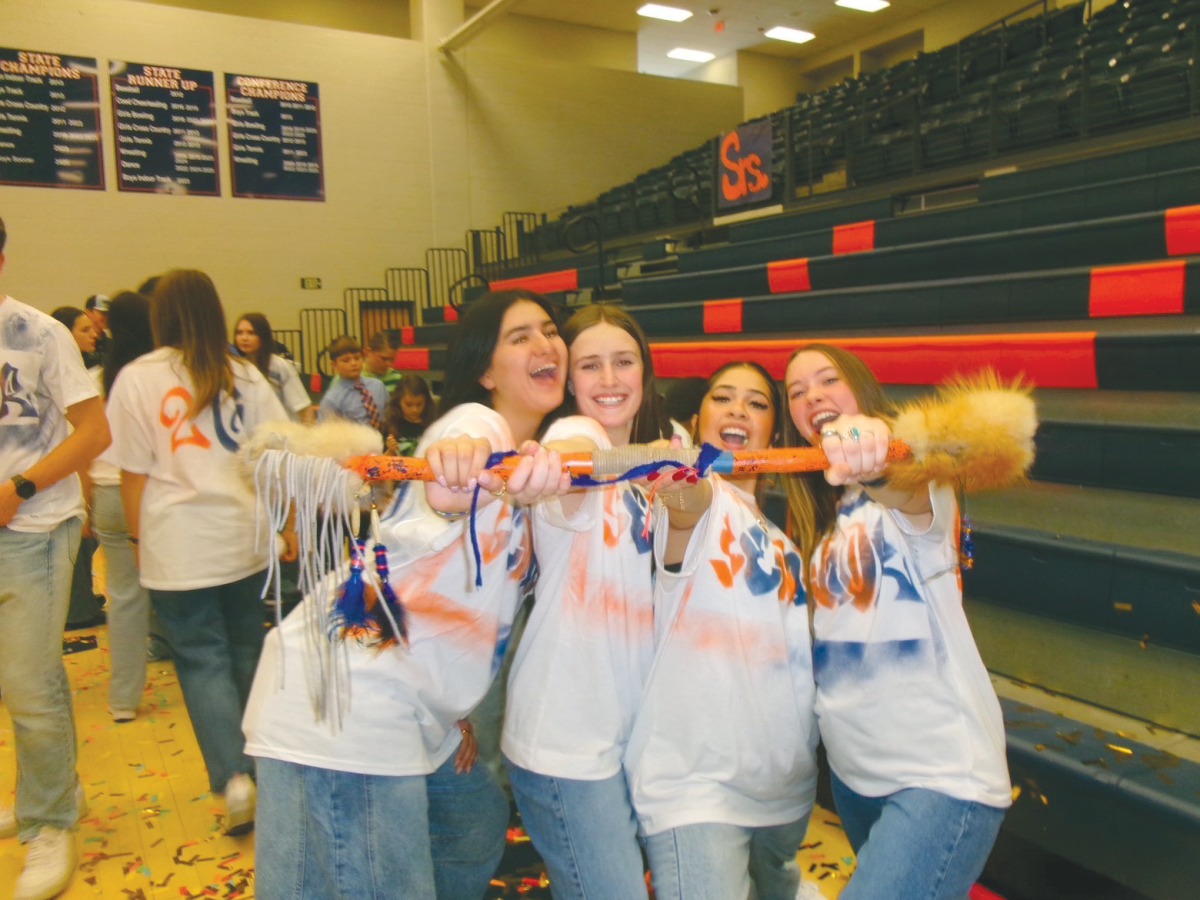
Heritage has built a long history with FBLA, from the student teacher volleyball game to fundraisers like FBrewLA. On Feb. 5, FBLA competed at Districts and had 10 competitors receive first place and the majority of students who competed qualified for state.
“If FBLA does end up getting dissolved, we hope that we leave this year on the best note possible and also carry in the culture, the spirit and the business experience into other parts of our school,” said Siwiec.