

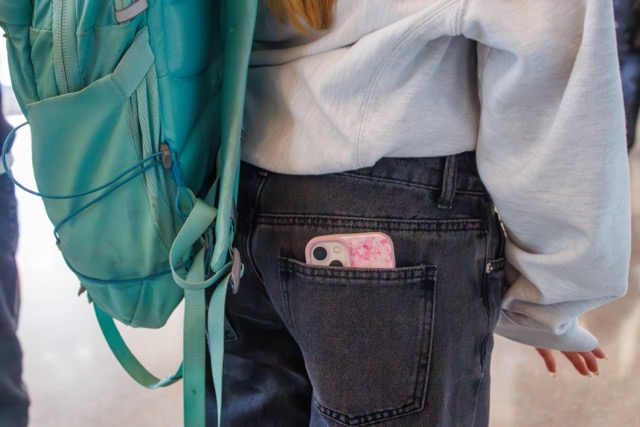
Arkansas Act 122 of 2025, also known as The “Bell to Bell, No Cell” Act, is a new state law that prohibits students in public schools from using personal electronic devices during the entire school day, from the first bell to the last bell. This includes cell phones, smartwatches, tablets, laptops, and Bluetooth-enabled devices, such as Air Pods.
This law was put into effect at the beginning of the 2025-2026 school year and states that devices may not be used in classrooms, hallways, restrooms, cafeterias or study areas. This includes having a phone on your body during the day and it is even preferred that the devices remain in students’ backpacks or off campus. The only exceptions to device usage are during emergency situations approved by school administration or for medical needs and IEP/504 plans. Of course, school-issued devices are acceptable.
Overall, many teachers have reported positive improvements in student engagement and participation since the implementation of the Act.
“My students in the classroom don’t even pull [their phones] out and are more engaged,” said English teacher Deanna Reed. She went on to say how the ban has even positively impacted students outside the classroom. “There’s less drama because someone is not on [social media talking] about how someone did something to someone else. [Also] people are talking more in the hallways; there is more one on one communication.”
While this law was passed with the expectation of said improvements, teachers are also realizing the reality of such a ban on technology.
“It’s been a learning experience. I’ve had to stop saying ‘get out your phone and take a picture’, [so] it has slowed down the teaching process some. But more students are engaged because they don’t have that option to take a picture and move on. But it’s been an adjustment for teachers and students,” said math teacher Jami Bice.
As it has been over two months since the start of the school year, administration reports an overall positive response. Admin even specifically noted the amount of push back from students is less than they were expecting.
Heritage’s disciplinary plan for students caught with devices includes 4 levels. The first step is a written warning telling the student to put their device away. The second step is having the phone confiscated in the office for the student to receive at the end of the day. The third step is having the phone in the office for the student’s parent/guardian to receive at the end of the day. The final step is the student being sent to in-school suspension (ISS).
“There were a lot of questions over the summer by both students and staff on how [the law is] going to work. I want to give credit to and shout out our students and our staff. I would say while we have some referrals, while we have some issues, it is nowhere near the level of disruption that we’ve seen in other districts throughout the state. Overall, I would say it’s been positive. We’ve had a couple dozen students we’ve talked to on an individual basis tell us how it’s going, and the vast majority say as long as no one else is on their phone the temptation to use [their] phone is less,” said Principal Chip Greenwell.
However, some students still find the ban unnecessary and/or annoying, especially those who weren’t part of the crowd who abused the phone usage during the past school years.
One of these students is Ashley Galdamez (12) who said, “I feel like it’s unnecessary for students who are in class, actually take school seriously, have good grades and show up on time. I don’t feel like it is necessary to put our phones away if you are responsible anyways.”
Despite all the differences of opinions on the law itself, Heritage staff and students will continue to adapt and thrive through the new regulations.